



2026 Year-End Financial To-Dos
Financial success is rarely the result of a single good decision, and instead is the culmination of disciplined planning, thoughtful risk management, and the ability to adapt as circumstances change.
Yet many investors approach a financial plan as something that is created once and referenced occasionally – rather than a tool that is evaluated as markets, legislation, and life priorities evolve.
We believe a well-constructed plan is valuable, and more importantly, that a regularly reviewed and rigorously stress-tested plan is essential.
A Financial Plan Is Only as Strong as Its Assumptions
Every financial plan is built on a framework of expectations about how the future may unfold – all of which is centered around your personal goals. These expectations include market returns, inflation, longevity, spending needs, and tax policy, which each influence those outcomes. At the time a plan is created, those inputs may be well-reasoned. Over time, however, even modest deviations can compound into meaningful differences in long-term results, especially for investors with complex portfolios, concentrated positions, or multi-generational goals.
Regular review ensures that planning remains grounded in current reality rather than anchored to outdated projections. Without this recalibration, confidence in a plan may persist even as its underlying assumptions quietly erode.
There’s a Difference Between Monitoring Performance and Testing Outcomes
Many investors track portfolio performance closely. Far fewer evaluate whether their overall strategy remains aligned with their long-term objectives.
This distinction matters. Performance answers: How did my investments do? Planning answers: Am I still on track to achieve what matters most?
Stress testing bridges these two perspectives by connecting unknown market behavior to real-life outcomes.
What Stress Testing Actually Measures
A stress test evaluates how your financial plan performs across a wide range of potential economic and market environments. Rather than assuming one path forward, it models many possible futures. A Monte Carlo analysis, such as the one shown below, will run numerous variations of data to evaluate the resilience of a financial plan.
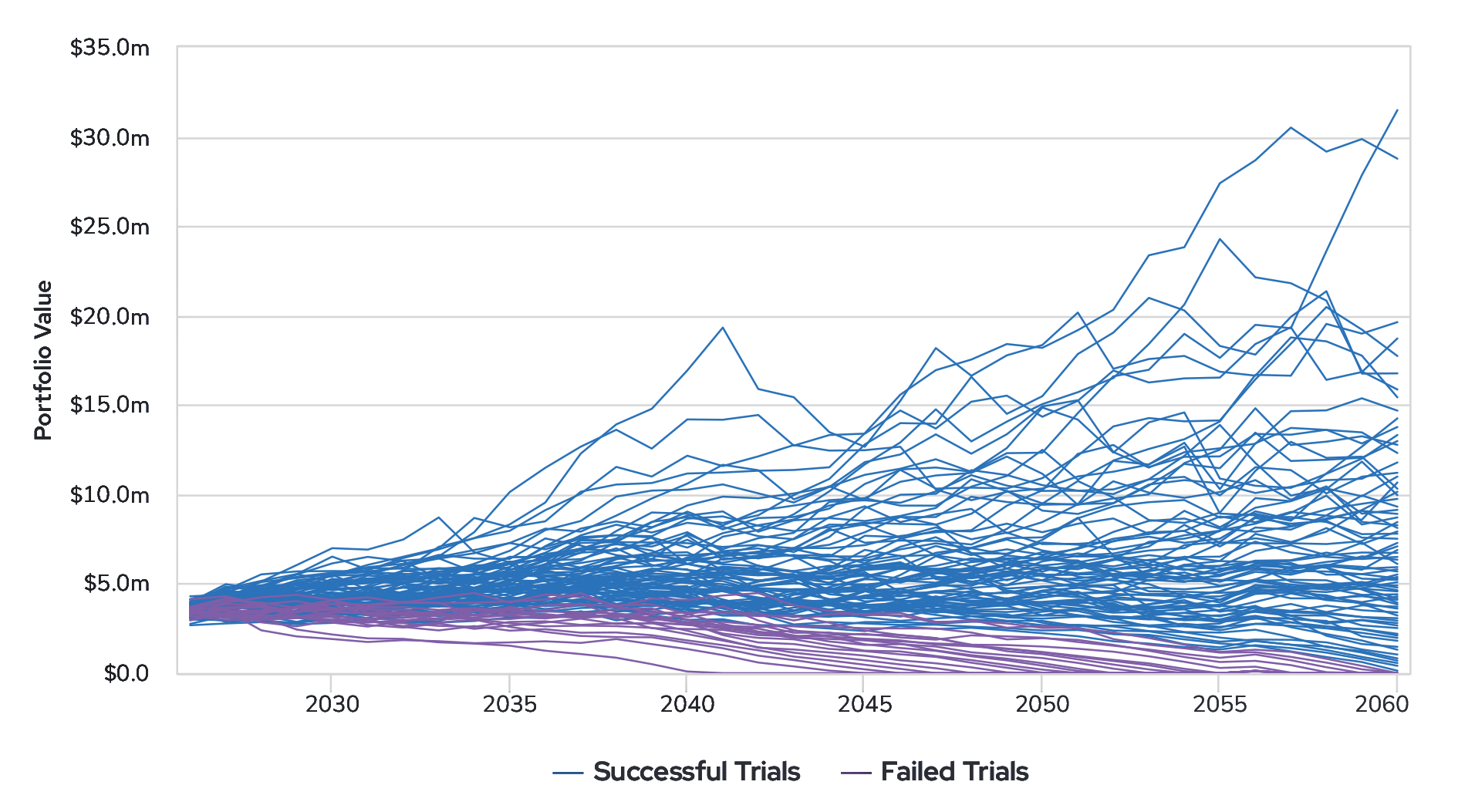
For illustrative purposes only.
This type of analysis adjusts and examines:
- Market downturns early or late in retirement
- Periods of sustained inflation
- Lower-than-expected investment returns
- Changes in spending patterns
- Unexpected longevity
- Tax environment shifts
This approach allows investors to see how the timing of market downturns could influence sustainability, how prolonged inflation may affect purchasing power, and how shifts in spending or tax policy could alter long-term flexibility. Instead of presenting a single projection, stress testing produces a probability-based view of resilience across many possible futures.
The goal is not to predict what will happen, but to understand what could happen and how prepared the plan is to withstand it.
Understanding Your Plan’s Probability of Success
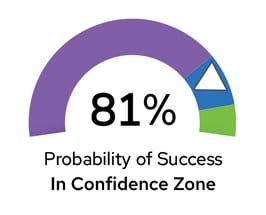
For many, success is often associated with investment performance. However, with this perspective, a probability-of-success framework shifts the focus from returns alone to the sustainability of outcomes over time.
This measure evaluates the likelihood that a person’s income and assets can support lifestyle needs, family goals, tax obligations, and legacy intentions across a defined period. By analyzing a thousand potential market paths, the framework translates uncertainty into a measurable confidence range.
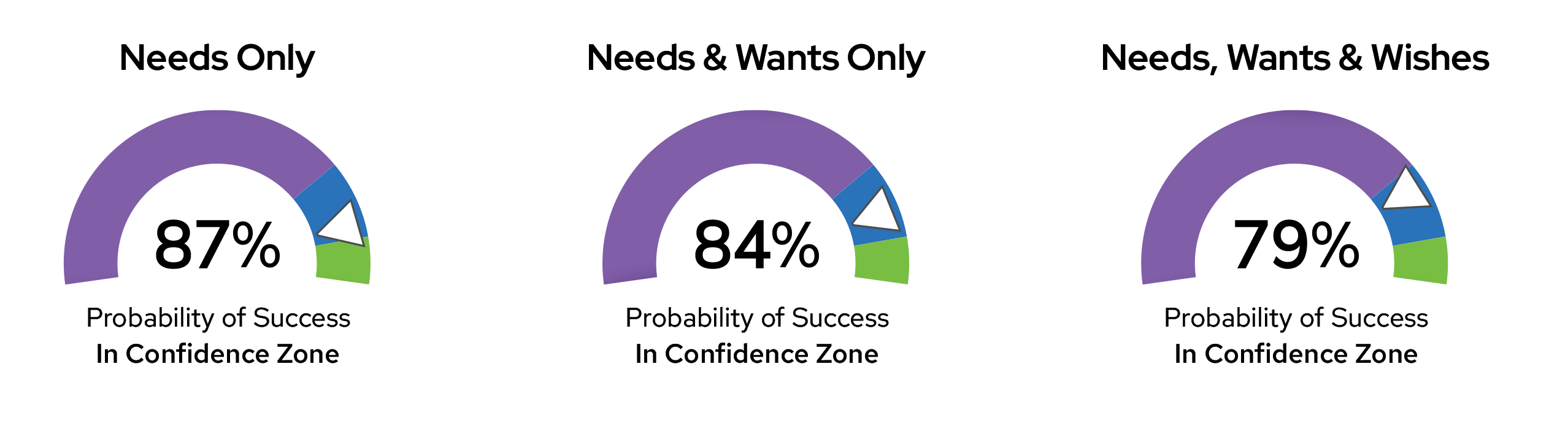
Importantly, the result is not a verdict but a guide. When the probability of a successful outcome is lower than hoped, this analysis can direct and highlight where adjustments can be made to meaningfully improve the plan, which are often achieved through measured, proactive changes rather than dramatic shifts. Sometimes small incremental changes in contribution rates, retirement dates, as well as a reduction in debt to lower retirement spending can all add up and have a dramatic positive impact on outcomes.
Additionally, stress testing can also drill down and identify the greatest threats to your financial success and future. These can be things such as Social Security cuts, a less than favorable return environment, and higher than expected or completely unexpected healthcare costs. Proactively identifying these risks can help mitigate them long before they potentially occur.
Stress Testing Reveals Opportunities, Not Just Risks
While stress testing is often associated with identifying risks, its value extends equally to opportunity discovery. A thorough analysis can reveal where a plan has greater flexibility than previously assumed, opening the door to decisions that may enhance financial confidence, improve tax efficiency, or strengthen outcomes.
In some cases, investors discover they can accelerate gifting strategies or adjust spending with confidence. In others, the analysis may reveal that certain complexities add cost without improving results. By clarifying both constraints and capacity, stress testing supports decisions that are not only safer, but more intentional.
In other words, stress testing is not about preparing for worst-case scenarios alone. It is about optimizing decisions with greater clarity.
The Cost of Not Stress Testing a Financial Plan
Without structured evaluation, planning becomes reactive. Decisions are made in response to market events rather than in anticipation of them. And as stated previously, mistakes made near retirement, or in retirement can often be more difficult to correct on a course.
For high-net-worth individuals, this can create hidden risks that stem from:
- Overconfidence driven by strong market periods
- Underestimation of longevity and inflation impacts
- Missed tax planning windows
- Unintended concentration risk
- Reduced flexibility when adjustments become necessary
Not evaluating a plan, and its success against a variety of environments and factors won’t affect the risk within the plan and will instead simply leave it unmeasured.
Finding Confidence, No Matter the Headlines
A financial plan should do more than outline a path forward. It should provide clarity about how resilient that path remains. For many investors, the most valuable insight is not a projection, but a deeper understanding of how their strategy performs when conditions are less predictable. This can provide them with clarity and a realistic projection of whether their plan is on solid footing or needs some adjustment to ensure long-term success.
This clarity is measured in confidence, not just performance. Confidence that your strategy has been evaluated across uncertainty. Confidence that tradeoffs are understood. And confidence that decisions are intentional rather than reactive. In an environment where markets, tax rules, and personal priorities continue to evolve, resilience becomes the defining measure of financial strength.
A structured stress test offers an opportunity to evaluate confidence with greater precision, and transforms planning from a one-time exercise into an ongoing process of measurement, adjustment, and refinement.
Please consult with an attorney or a tax or financial advisor regarding your specific legal, tax, estate planning, or financial situation. The information in this article is not intended as legal or tax advice.